A not uncommon term to find in the religious world, especially in the United States, is the "free church." Sometimes this is found in the name of a individual congregation, and sometimes in a "group" name.
There are actually three meanings to this term "free church."
The first and most common is found in Wikipedia and elsewhere:
Historically, we are told "The term, free church refers to a Christian denomination that is intrinsically separated from government (as opposed to a theocracy, or an "established" or state church). The term is especially relevant in countries with established state churches."
Obviously, by this definition, most of us would think that ALL churches are "free churches" in the United States today, since the United States do not have established state church(es). However, as a number of people have pointed out there are "state churches" and "state churches." The act of making a church corporation in accordance with state laws ("incorporating") is a way of becoming a "state church," as is seeking recognition from the IRS as a "church" or 501c3 organization. This idea is discussed in more detail later.)
The second relates to individual congregations, which are churches that are (or at least claim to be) "congregational" in organization: they do not fall under the control of some "higher" organization like a "synod" or a "diocese" or some sort of similar denominational group. Such a group of churches that claim this status is:
"Lutheran Free Churches" were formed in the 1970s by two Minnesota professors who "determined that according to the New Testament the local congregation was the correct form of God's kingdom on earth" but ironically, in 1897 formed an "association" called Lutheran Free Churches in 1897, which merged with the American Lutheran Church, a denomination, in 1963. Forty congregations which did not agree with the ALC merger continued as the "Association of Free Lutheran Congregations." With more than 250 congregations, the AFLC claims that its congregations are autonomous but has multiple corporations "to direct their common endeavors." Free apparently does not mean "free" for the "Free Lutheran Congregations.
We find something similar for the Evangelical Free Churches of America, which says of itself: United by a mutual commitment to serve our Lord Jesus Christ with the guidance of the Holy Spirit and obedience to the Word of God, the Evangelical Free Church of America is an association of nearly 1,500 churches and church plants in a growing ministry that currently extends to some 75 countries of the world. Wikipedia calls the EFCA a denomination and that seems to be the case. Most churches in America who call themselves a "Free Church" seem to be parts of this EFCA denomination, even though they often do not use the word "Evangelical" in their name.
There are, however, many churches which DO adhere to this idea of "free church," that is, churches (local congregations) which are autonomous, recognize and belong to NO "parent organization" including synods, associations, societies, cooperative assemblies, or anything else on earth. These churches claim no earthly headquarters at all, and that they are responsible to, and members of, only Christ Jesus himself. They often use very different names, including just plain "Church," but commonly-used names include "Christian Church," "Church of Christ," "Church of God," and "Bible Church." Most (but not all) are like one church in Vallejo, California: "There are no governing boards -- neither district, regional, national, or international. Each congregation is autonomous (self-ruled). Each congregation is governed locally by a plurality of elders."
The third use of "free church" refers to what are also called "Unregistered Churches." These are churches which refuse to have anything to do with government agencies, such as the IRS, do not incorporate or operate as any sort of trust or business, and do not obtain "recognition" via such things as a Employer Identification Number" (EIN). A good description of this kind of "free church" is found at the "The Free-Church Solution", which says in part: "A great many of the church's problems today are a direct result of the church "taking" and actively pursuing a legal status that makes it inferior to, and a subordinate of, the civil government. The two most significant ways this occurs is by incorporation (state jurisdiction) and the tax-exempt 501c3 status (federal jurisdiction)."
To understand this reasoning, it is good to refer to an IRS Publication In that, on page 27, we find the closest thing to a government (IRS) definition of "church:"
Church. Certain characteristics are generally attributed to churches.
These attributes of a church have been developed by the IRS and
by court decisions. They include:
-distinct legal existence;
-recognized creed and form of worship;
- definite and distinct ecclesiastical government;
- formal code of doctrine and discipline;
- distinct religious history;
- membership not associated with any other church or denomination;
- organization of ordained ministers;
- ordained ministers selected after completing prescribed courses of study;
- literature of its own;
- established places of worship;
- regular congregations;
- regular religious services;
- Sunday schools for the religious instruction of the young;
- schools for the preparation of its ministers.
The IRS generally uses a combination of these characteristics,
together with other facts and circumstances, to determine whether
an organization is considered a church for federal tax purposes.
The IRS makes no attempt to evaluate the content of whatever
doctrine a particular organization claims is religious, provided the
particular beliefs of the organization are truly and sincerely held by
those professing them and the practices and rites associated with
the organization’s belief or creed are not illegal or contrary to
clearly defined public policy.
Keep in mind, this is an official IRS (US Government) publication, explaining the law. It is easy to see why some people want to have their local congregation free of this. Yet, even many churches which are "free" in the sense of being autonomous congregations routinely do incorporate, obtain verification of 501c3 status, and obtain EIN and other recognition by federal, state, and sometimes local agencies. Many of them teach this is a necessity in the world (and especially the United States), citing Romans 13:1-8 and 1 Peter 2:13-14.
That, at least, is a very common misunderstanding. As the website "hushmoney.com" explains, though: "IRC 508c1A and IRS Publication 557 make it clear that a church is "automatically tax-exempt" without having to apply for 501c3 status. The reason that churches aren't taxed is because of the "charitable and religious" activities they engage in. If you organize a real church, it doesn't matter to the IRS whether you organize as a church, as an unincorporated association, as a non-profit corporation, or as a corporation sole. The legal manner in which you organize a church is irrelevant for tax purposes. Provided that it really is a church, it's always automatically tax exempt without having to apply for 501c3 status."
What does the Bible teach, and specifically, what is found in the New Testament beyond these two passages?
We shall look at that in the next posting.
Saturday, December 04, 2010


Thursday, December 02, 2010
Defending ourselves from evil doers
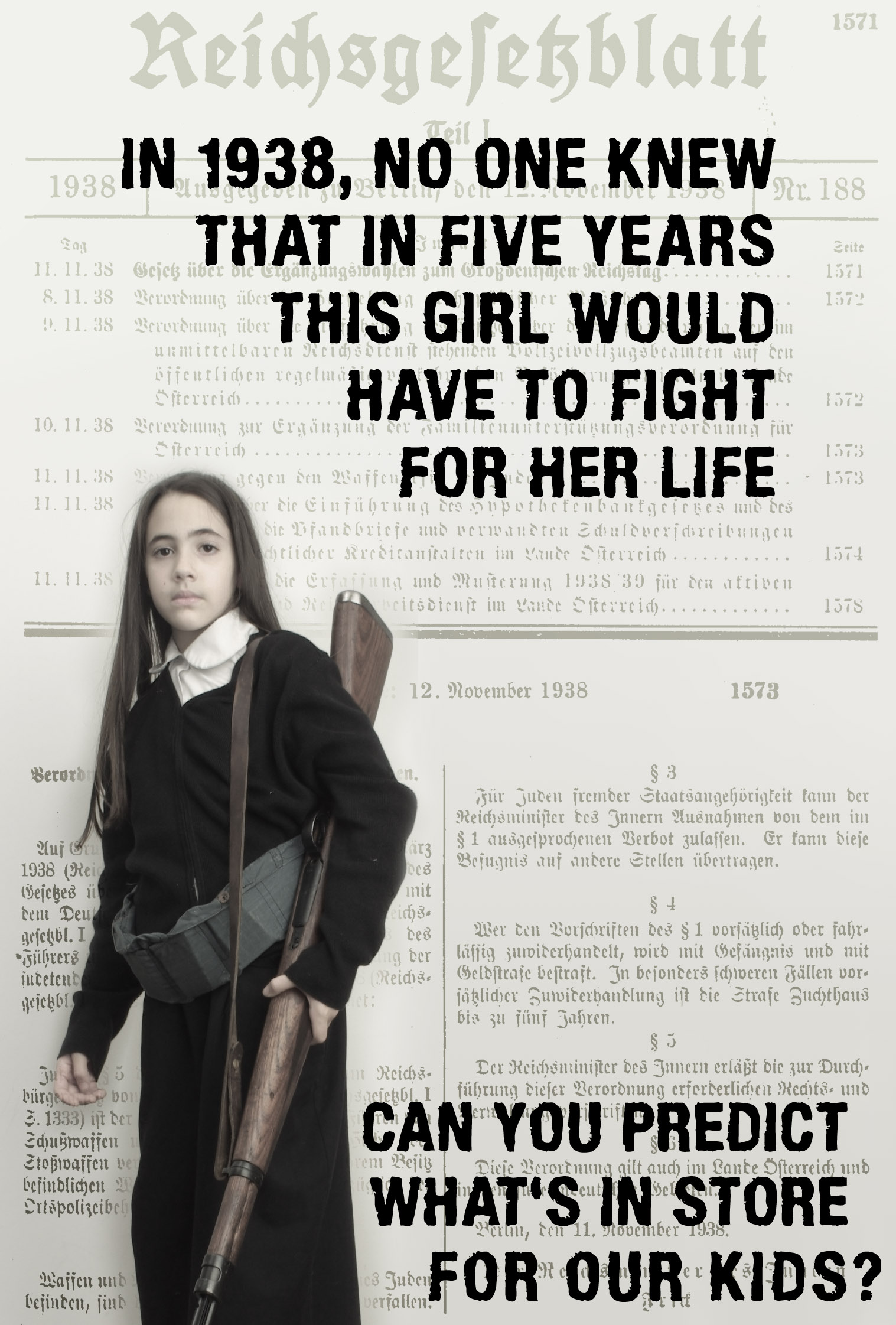
Another of Oleg Volk's evocative photo-posters.
In Scripture, we find a large number of examples of self-defense, both in the Old and New Testaments. Here are just a few:
Luke 22:36-38 - Jesus commands His disciples to buy a sword for their travels preaching the Gospel.
Acts 18:12-16 - Paul accepted the use of the physical power of the state to protect him from the angry Jews. Either some city troops or Jews or Paul's converts beat Sosthenes (leader of the synagogue) apparently in an attempt to stop his persecution of Paul, and Paul did not intervene. (v 17)
Acts 21 - Paul accepted his personal defense by Roman troops against his own Jewish people in the Temple forecourt. In Chapter 23, he again accepted defense by Roman troops against an assassination attempt.
But the best defense is to take the offense: to preach and convert the evil doers of the world into followers of the Christ - we will never succeed in converting every sinner, every future government thug, but enough, and the darkness that descended over 20th Century Europe will not be nearly so dark, and the light will return sooner, while God's kingdom is spread.
Thursday, November 25, 2010
Liberalism - a totalitarian threat to freedom
That is one reason "feelings" and "compassion" are two of the most often used liberal terms. "Character" is no longer a liberal word because it implies self-restraint. "Good and evil" are not liberal words either as they imply a moral standard beyond one's feelings. In assessing what position to take on moral or social questions, the liberal asks him or herself, "How do I feel about it?" or "How do I show the most compassion?" -- not "What is right?" or "What is wrong?" For the liberal, right and wrong are dismissed as unknowable, and every person chooses his or her own morality. -- Dennis Prager
Although Dennis refers to "liberalism" in this quote, it applies to the whole spectrum of the so-called left: Socialists, Communists (International Socialists), National Socialists, and Transnational Socialists (Progressives).
An example of this can be seen in an incident related by Jeff Hamilton of La Vista, Nebraska. He relates the response to one of his web articles encouraging young people to reject pre-marital sex: 'Though not the author’s intention, I received an illustration of this very thing. “When you look over these posts and see how miserable and guilty the children that you advise feel about their "sins" don't you regret the way you teach? God loves us all no matter what mistakes we make and it would be nice to find some Christians that teach the love and not the wrath. Unless the reader can read and clearly understand Hebrew, Arabic, and many of the other languages of the original Bible, I think it is almost hypocritic to spread guilt based on third and fourth level translations. I don't mean to criticize and I definitely respect what you are doing, I think its great trying to help young men and women with their most intimate of problems, but maybe sometimes the answer shouldn't just be 'you've sinned, you're making up excuses.' It's clear that some people have justified pre-marital sex in their own lives and you will likely be unable to change that, but your practical advise on what actions to take should be based on if they continue their ways. I’m sure would be much more valuable to them than judging them. It's not our place to judge or dictate who has the rights of passage into our father's [sic] kingdom. Although I don't expect it to, I will pray that my wisdom has a flicker on your thoughts.”'
As Jeff Hamilton points out:
1. Here is a man who doesn’t care about right and wrong, he just doesn’t want anyone to feel guilty.
2. Here is a man who thinks that no one can do wrong.
3. Here is a man sitting in judgment when someone teaches God’s truth.
Sadly, that means this man is a perfect example of a typical liberal.
Paul the Apostle warned us of this (and gave us the solution), in Ephesians 4:14-16.
It is one that applies both in the church and in the community.
Although Dennis refers to "liberalism" in this quote, it applies to the whole spectrum of the so-called left: Socialists, Communists (International Socialists), National Socialists, and Transnational Socialists (Progressives).
An example of this can be seen in an incident related by Jeff Hamilton of La Vista, Nebraska. He relates the response to one of his web articles encouraging young people to reject pre-marital sex: 'Though not the author’s intention, I received an illustration of this very thing. “When you look over these posts and see how miserable and guilty the children that you advise feel about their "sins" don't you regret the way you teach? God loves us all no matter what mistakes we make and it would be nice to find some Christians that teach the love and not the wrath. Unless the reader can read and clearly understand Hebrew, Arabic, and many of the other languages of the original Bible, I think it is almost hypocritic to spread guilt based on third and fourth level translations. I don't mean to criticize and I definitely respect what you are doing, I think its great trying to help young men and women with their most intimate of problems, but maybe sometimes the answer shouldn't just be 'you've sinned, you're making up excuses.' It's clear that some people have justified pre-marital sex in their own lives and you will likely be unable to change that, but your practical advise on what actions to take should be based on if they continue their ways. I’m sure would be much more valuable to them than judging them. It's not our place to judge or dictate who has the rights of passage into our father's [sic] kingdom. Although I don't expect it to, I will pray that my wisdom has a flicker on your thoughts.”'
As Jeff Hamilton points out:
1. Here is a man who doesn’t care about right and wrong, he just doesn’t want anyone to feel guilty.
2. Here is a man who thinks that no one can do wrong.
3. Here is a man sitting in judgment when someone teaches God’s truth.
Sadly, that means this man is a perfect example of a typical liberal.
Paul the Apostle warned us of this (and gave us the solution), in Ephesians 4:14-16.
It is one that applies both in the church and in the community.
Tuesday, November 23, 2010
A look at liberalism
"My analysis is that most faith based systems depend upon an absolute moral order. The declaration of things as absolutely evil or absolutely good, as sin or virtue, puts liberalism into a horrible position because it's founded on no judgment on anything. As a result, any faith that is seriously practiced or understood is a challenge to the politics that depend on constituencies that would rather not be told that their choices are bad and their lives are not virtuous." -- Hugh Hewitt
Faith in Christ Jesus - saving, obedient faith (not that of demons and the pharisees) - demands acceptance of an "absolute moral order" as established by God in His Word. Christians know that things can be absolutely good - or in the absence of good (and God), absolutely evil. Thus, it is not possible for liberalism to be compatible with the "pure and undefiled religion" of which James speaks (James 1:27). Therefore, liberalism is not compatible with any human government which hopes to prove it is acceptable to God (if indeed such exists). Why? Because if there IS a justification for government, its role (per the Bible) is to DISCOURAGE EVIL by punishing it. Only in that way does government promote "GOOD." But since liberalism cannot and will not judge what is evil or what is good, it is incapable of carrying out this primary function.
Ultimately, a government based on principles of this liberalism will become the open enemy of God and our worship of Him. It will seek (as so many modern governments do) to dictate what is politically correct (and therefore "good") based on relative ideas and not absolute values. It turns the universe upside down, substituting the wishes of man for the laws of God. Then, we must decide whether such a government can be tolerated (ignored for the most part) or whether we must take actions to defend ourselves against it, up to the point reached by the Founding Fathers: rebellion and overthrow of the evil regime.
Faith in Christ Jesus - saving, obedient faith (not that of demons and the pharisees) - demands acceptance of an "absolute moral order" as established by God in His Word. Christians know that things can be absolutely good - or in the absence of good (and God), absolutely evil. Thus, it is not possible for liberalism to be compatible with the "pure and undefiled religion" of which James speaks (James 1:27). Therefore, liberalism is not compatible with any human government which hopes to prove it is acceptable to God (if indeed such exists). Why? Because if there IS a justification for government, its role (per the Bible) is to DISCOURAGE EVIL by punishing it. Only in that way does government promote "GOOD." But since liberalism cannot and will not judge what is evil or what is good, it is incapable of carrying out this primary function.
Ultimately, a government based on principles of this liberalism will become the open enemy of God and our worship of Him. It will seek (as so many modern governments do) to dictate what is politically correct (and therefore "good") based on relative ideas and not absolute values. It turns the universe upside down, substituting the wishes of man for the laws of God. Then, we must decide whether such a government can be tolerated (ignored for the most part) or whether we must take actions to defend ourselves against it, up to the point reached by the Founding Fathers: rebellion and overthrow of the evil regime.
Monday, November 22, 2010
More thoughts on John Locke's limits of government
We can look at a few practical examples of how this principle (discussed in the last post) is (or should be) applied.
As Christians - and as humans, period - God has given us NO power to force people to "do good." We may take (within limits) actions to keep people from doing evil, or to at least respond to their evil actions. But we cannot force someone to worship God, to sing praises to Him, to pray to Him, to give in benevolence, or even to accept Jesus as Lord and Savior and be buried with Him in baptism. There is no scriptural authority to do this. There is no reason to believe that such authority exists for ANY moral action.
Yet, government claims to be able to force people to do good to others, by collecting money from people and then giving some of that money to the needy as charity (or welfare). Beyond the complete lack of ANY constitutional authority to do, government has no authority granted by God to do so. Indeed, were an individual person to try and take money from someone else, even with the intent of using it to feed the hungry, cloth the naked, or house the homeless, that individual would be recognized immediately for what he is: a thief.
We as Christians are told (by God) to feed the hungry, cloth the naked, care for the sick, and many other things. But NOWHERE in the Bible are we told that we can steal or take money from others to do these good deeds with, OR that our obligation to God is met by having someone else (like government) do this.
And therein lies the reason that Christians cannot support the ideas (or "ideals") of "social justice" and why people are correct when they say that churches who advocate social justice are NOT advocating true and undefiled religion, no matter how much they try to quote the Epistle of James to support their claims. Government programs of "social justice" require that government, and government agents, do things that God DOES prohibit and condemn as being sin.
Government can have nothing to give to others unless it first takes it from someone else. It does this, almost exclusively, by forcing people to "give" money to government, which it then gives (minus a handling fee, of course) to the objects of welfare. How can any church reconcile this (and supporting government's power to do this) with clear scriptural commands not to steal, and to give freely as we have been prospered?
It cannot. And neither can government. If government is not subject to limits imposed by God on the humans that make up that government, it has no limits. More, it is in rebellion to God.
As Christians - and as humans, period - God has given us NO power to force people to "do good." We may take (within limits) actions to keep people from doing evil, or to at least respond to their evil actions. But we cannot force someone to worship God, to sing praises to Him, to pray to Him, to give in benevolence, or even to accept Jesus as Lord and Savior and be buried with Him in baptism. There is no scriptural authority to do this. There is no reason to believe that such authority exists for ANY moral action.
Yet, government claims to be able to force people to do good to others, by collecting money from people and then giving some of that money to the needy as charity (or welfare). Beyond the complete lack of ANY constitutional authority to do, government has no authority granted by God to do so. Indeed, were an individual person to try and take money from someone else, even with the intent of using it to feed the hungry, cloth the naked, or house the homeless, that individual would be recognized immediately for what he is: a thief.
We as Christians are told (by God) to feed the hungry, cloth the naked, care for the sick, and many other things. But NOWHERE in the Bible are we told that we can steal or take money from others to do these good deeds with, OR that our obligation to God is met by having someone else (like government) do this.
And therein lies the reason that Christians cannot support the ideas (or "ideals") of "social justice" and why people are correct when they say that churches who advocate social justice are NOT advocating true and undefiled religion, no matter how much they try to quote the Epistle of James to support their claims. Government programs of "social justice" require that government, and government agents, do things that God DOES prohibit and condemn as being sin.
Government can have nothing to give to others unless it first takes it from someone else. It does this, almost exclusively, by forcing people to "give" money to government, which it then gives (minus a handling fee, of course) to the objects of welfare. How can any church reconcile this (and supporting government's power to do this) with clear scriptural commands not to steal, and to give freely as we have been prospered?
It cannot. And neither can government. If government is not subject to limits imposed by God on the humans that make up that government, it has no limits. More, it is in rebellion to God.
Limits on government - John Locke
"The people cannot delegate to government the power to do anything which would
be unlawful for them to do themselves." ... whenever the Legislators endeavor
to take away, and destroy the Property of the People, or to reduce them to
Slavery under Arbitrary Power, they put themselves into a state of War with the
People, who are thereupon absolved from any farther Obedience, and are left to
the common Refuge, which God hath provided for all Men, against Force and
Violence. Whensoever therefore the Legislative shall transgress this
fundamental Rule of Society, and either by Ambition, Fear, Folly or Corruption,
endeavor to grasp themselves, or put into the hands of any other an Absolute
Power over the Lives, Liberties, and Estates of the People; By this breach of
Trust they forfeit the Power the People had put into their hands, for quite
contrary ends, and it devolves to the People, who have a Right to resume their
original Liberty."
-- John Locke
John Locke here expresses an essential principle for Christians, whether in the First Century or in the Twenty-first Century. It is not possible for ANY group of people to do anything AS A GROUP which they are not authorized by God to do individually: indeed, Scripture shows that groups of people - even churches organized in accordance with the New Testament have no more authority to make laws, override God's commands, punish people, or anything else than the individual Christians which make up that church. How much more does this principle apply to human, secular government?
Locke also points out the logical corollary to that principle: Attempts by human rulers to take that power not granted to them by God forfeit ALL power, and the people are thereby free, in the eyes of God, to resume their original liberty. That is the liberty which is God's gift to all humans.
be unlawful for them to do themselves." ... whenever the Legislators endeavor
to take away, and destroy the Property of the People, or to reduce them to
Slavery under Arbitrary Power, they put themselves into a state of War with the
People, who are thereupon absolved from any farther Obedience, and are left to
the common Refuge, which God hath provided for all Men, against Force and
Violence. Whensoever therefore the Legislative shall transgress this
fundamental Rule of Society, and either by Ambition, Fear, Folly or Corruption,
endeavor to grasp themselves, or put into the hands of any other an Absolute
Power over the Lives, Liberties, and Estates of the People; By this breach of
Trust they forfeit the Power the People had put into their hands, for quite
contrary ends, and it devolves to the People, who have a Right to resume their
original Liberty."
-- John Locke
John Locke here expresses an essential principle for Christians, whether in the First Century or in the Twenty-first Century. It is not possible for ANY group of people to do anything AS A GROUP which they are not authorized by God to do individually: indeed, Scripture shows that groups of people - even churches organized in accordance with the New Testament have no more authority to make laws, override God's commands, punish people, or anything else than the individual Christians which make up that church. How much more does this principle apply to human, secular government?
Locke also points out the logical corollary to that principle: Attempts by human rulers to take that power not granted to them by God forfeit ALL power, and the people are thereby free, in the eyes of God, to resume their original liberty. That is the liberty which is God's gift to all humans.
Sunday, November 21, 2010
Two classes of people
James Bovard, in a recent blog posting: http://jimbovard.com/blog/2010/11/10/statism-the-greatest-threat/ wrote:
"Trusting contemporary governments means dividing humanity into two classes: those who can be trusted with power to run other people’s lives, and those who cannot even be trusted to run their own lives. Modern Leviathans give some people the power to play God with other people’s lives, property, and domestic tranquility. Modern political thinking presumes that restraints are bad for the government but good for the people. The first duty of the citizen is to assume the best of the government, while government officials assume the worst of him."
Although Bovard does not write from a religious perspective, he has made a point that has religious implications. Where in the Bible can we find this division of humanity? New Testament Christianity makes exactly the opposite assumptions: that NO one can be trusted with power to run other people's lives, and that people are expected to run their own lives: i.e., that we humans have responsibility (to GOD) for what we do and say.
Thus we have another reason to reject "modern political thinking," as Bovard describes it.
"Trusting contemporary governments means dividing humanity into two classes: those who can be trusted with power to run other people’s lives, and those who cannot even be trusted to run their own lives. Modern Leviathans give some people the power to play God with other people’s lives, property, and domestic tranquility. Modern political thinking presumes that restraints are bad for the government but good for the people. The first duty of the citizen is to assume the best of the government, while government officials assume the worst of him."
Although Bovard does not write from a religious perspective, he has made a point that has religious implications. Where in the Bible can we find this division of humanity? New Testament Christianity makes exactly the opposite assumptions: that NO one can be trusted with power to run other people's lives, and that people are expected to run their own lives: i.e., that we humans have responsibility (to GOD) for what we do and say.
Thus we have another reason to reject "modern political thinking," as Bovard describes it.
Friday, November 19, 2010
A Voice of Freedom in today's world
This is the second part of a multi-part post. Please feel free to read the first part "New Manager - Voice of Freedom" below.
Like the old Voice of Freedom (1953-1985) the new blog-version intends to fight against totalitarianism: all forms of it. These will include at least:
- Communism in its revival
- Socialism in all its various forms
- Transnational progressivism
- American liberalism
- American neo-conservatism
- American paleo-conservatism
- Religious hierarchies of whatever flavor or denomination
- Islam
- Humanism and its sisters of atheism and feminism
I am not adverse to adding other "isms" to this list. At the same time, I want it to be clear to all readers: I do NOT wish ill for anyone involved in these forms of tyranny, even leaders. I am not advocating ANY reason to attack someone for their race, ancestry, national origins, or political or religious beliefs - PROVIDED that they do not seek to steal our own liberties away from others.
To that end, the Voice of Freedom will be both blunt and explicit. (I could say, "call a spade a spade," but that expression is often claimed to be bigoted. Don't know why: there is a definite difference between a shovel, a spade, and any other sort of tool for digging up dirt and rocks.) I am not interested in being politically correct; I am not interested in coddling anyone. But I also realize that I answer to God for everything I say and do not say. I do not wish to harm anyone needlessly, and definitely do not wish to drive off people who would otherwise listen to me, and perhaps heed my words, if not now, then in the future.
I do wish it to be clear to all readers, old and new, that this publication, this blog, expresses a very ancient view of both religion AND politics. I no more favor "statements of faith" than I favor "loyalty oaths" for anyone or anything. But I (obviously) do believe in God, and that the Bible is the inspired Word of God, that Jesus the Messiah is the Son of God and the ONLY door to salvation for man and woman now and in the future, and that we humans are saved by faith - a faith expressed in obedience to God. I do believe that it is possible to lose that obedient faith and therefore lose our salvation, until we die "and then comes judgment." At that Day of judgment, all of us (faithful and unfaithful) will answer for the deeds that we have done, and Jesus' intercession for the faithful will make up for our lack of perfection, and our failure to keep God's commands as we have the ability to do. In this life, we must seek to serve God in accordance with His will and not our own or that demanded by others. I believe that the Bible is the ONLY authority that we have in matters of life and religion: that there is no modern-day revelation, that God does not give us special instructions even though His Spirit dwells in us.
Equally, let it be known that I (and therefore this publication) express a very ancient view of human freedom and government. God gave us free will: He created humans in His image. But He IS the Creator. To the extent that ANY sort of human government can (or should) exist, it MUST be in accordance with God's will. Therefore, any human government must be very limited: indeed, there is strong reason to state that ANY government beyond that of the family and the church and voluntary cooperation is nothing but rebellion against God.
Lest this be viewed as some form of totalitarian theonomy that this blog is espousing, understand that God does not give mere men ANY AUTHORITY to enforce His laws: at most we may take measures to protect ourselves, our families, and our brethren in Christ from internal and external threats, and that the greatest power available to the church or family to do that is exclusion or withdrawal - although God clearly gives us the right to defend ourselves and one another. But no human has any right to revenge or vengeance: God reserves that to Himself.
I understand that this is a radical position: the idea that no government (except that of family and church) is better than any human-conceived government, if push comes to shove. I welcome those who can show in the Scriptures that any human government has the right to usurp God's prerogatives as the Creator, and any authority to use force except in self-defense. God did not make one set of moral law for individual humans and another set for groups of humans.
To these ends, this publication intends to provide intellectual ammunition for believers (and others) to fight against totalitarianism, and tyranny in all its forms. And to also show more fully the Way of the Lord both to those who are faithful believers AND to those who want to become such. This blog will not be limited to my own (Edward's) writings and thoughts: I will borrow freely from others, going all the way back to Job and Abraham and Moses, and ranging through the ages right up to today in 2010 and ahead. In some cases, I will attribute to the author; in others I may not, either because they do not wish it to be so, or for the protection of those others.
As I've mentioned already, I welcome comments, criticisms, and yes, even hate mail.
Edward, November 21st, A.D. 2010, A.L. 235.
Like the old Voice of Freedom (1953-1985) the new blog-version intends to fight against totalitarianism: all forms of it. These will include at least:
- Communism in its revival
- Socialism in all its various forms
- Transnational progressivism
- American liberalism
- American neo-conservatism
- American paleo-conservatism
- Religious hierarchies of whatever flavor or denomination
- Islam
- Humanism and its sisters of atheism and feminism
I am not adverse to adding other "isms" to this list. At the same time, I want it to be clear to all readers: I do NOT wish ill for anyone involved in these forms of tyranny, even leaders. I am not advocating ANY reason to attack someone for their race, ancestry, national origins, or political or religious beliefs - PROVIDED that they do not seek to steal our own liberties away from others.
To that end, the Voice of Freedom will be both blunt and explicit. (I could say, "call a spade a spade," but that expression is often claimed to be bigoted. Don't know why: there is a definite difference between a shovel, a spade, and any other sort of tool for digging up dirt and rocks.) I am not interested in being politically correct; I am not interested in coddling anyone. But I also realize that I answer to God for everything I say and do not say. I do not wish to harm anyone needlessly, and definitely do not wish to drive off people who would otherwise listen to me, and perhaps heed my words, if not now, then in the future.
I do wish it to be clear to all readers, old and new, that this publication, this blog, expresses a very ancient view of both religion AND politics. I no more favor "statements of faith" than I favor "loyalty oaths" for anyone or anything. But I (obviously) do believe in God, and that the Bible is the inspired Word of God, that Jesus the Messiah is the Son of God and the ONLY door to salvation for man and woman now and in the future, and that we humans are saved by faith - a faith expressed in obedience to God. I do believe that it is possible to lose that obedient faith and therefore lose our salvation, until we die "and then comes judgment." At that Day of judgment, all of us (faithful and unfaithful) will answer for the deeds that we have done, and Jesus' intercession for the faithful will make up for our lack of perfection, and our failure to keep God's commands as we have the ability to do. In this life, we must seek to serve God in accordance with His will and not our own or that demanded by others. I believe that the Bible is the ONLY authority that we have in matters of life and religion: that there is no modern-day revelation, that God does not give us special instructions even though His Spirit dwells in us.
Equally, let it be known that I (and therefore this publication) express a very ancient view of human freedom and government. God gave us free will: He created humans in His image. But He IS the Creator. To the extent that ANY sort of human government can (or should) exist, it MUST be in accordance with God's will. Therefore, any human government must be very limited: indeed, there is strong reason to state that ANY government beyond that of the family and the church and voluntary cooperation is nothing but rebellion against God.
Lest this be viewed as some form of totalitarian theonomy that this blog is espousing, understand that God does not give mere men ANY AUTHORITY to enforce His laws: at most we may take measures to protect ourselves, our families, and our brethren in Christ from internal and external threats, and that the greatest power available to the church or family to do that is exclusion or withdrawal - although God clearly gives us the right to defend ourselves and one another. But no human has any right to revenge or vengeance: God reserves that to Himself.
I understand that this is a radical position: the idea that no government (except that of family and church) is better than any human-conceived government, if push comes to shove. I welcome those who can show in the Scriptures that any human government has the right to usurp God's prerogatives as the Creator, and any authority to use force except in self-defense. God did not make one set of moral law for individual humans and another set for groups of humans.
To these ends, this publication intends to provide intellectual ammunition for believers (and others) to fight against totalitarianism, and tyranny in all its forms. And to also show more fully the Way of the Lord both to those who are faithful believers AND to those who want to become such. This blog will not be limited to my own (Edward's) writings and thoughts: I will borrow freely from others, going all the way back to Job and Abraham and Moses, and ranging through the ages right up to today in 2010 and ahead. In some cases, I will attribute to the author; in others I may not, either because they do not wish it to be so, or for the protection of those others.
As I've mentioned already, I welcome comments, criticisms, and yes, even hate mail.
Edward, November 21st, A.D. 2010, A.L. 235.
New Manager - Voice of Freedom
Let me introduce myself - sort of.
I'm Edward J. and a dear friend of mine has asked me to take over this blog, which he admits he has not given proper attention to, and which he believes has a lot of potential. Well, I think it does, so I'm going to try and see if I can carry his dream forward. He is not doing well, health- or time-wise, and yet he has a deep love for freedom and God, and wants to continue to support this, but in the background.
I want to discuss some ancient history, and then add my own thoughts. (You can add your thoughts too. Please!)
The Voice of Freedom was a colorful, 8.5 x 11 size magazine published by members of the church of Christ [as am I] for more than three decades. Founded by famous editor and preacher G. C. Brewer (1884-1956), it was dedicated to warning of the dangers of Roman Catholicism and Communism, which he viewed (correctly at the time) were forms of totalitarianism and that freedom would be lost if either of these systems were to gain control of the government of the United States. After bro. Brewer's death, L.R. Wilson (1896-1968) edited the publication, concentrating mostly on the threat posed by Roman Catholicism and those people who trusted in the Pope more than in God, and who followed the then-harsh doctrines and rule of the Roman Catholic Church. As Catholicism changed and declined in power and influence (in the aftermath of Vatican II and various other events), the Voice of Freedom started to shift its emphasis to the dangers of humanism, atheism, and materialism, and their threat to religious liberty, under the editorship of P. D. Wilmeth (1907-1987). The magazine attempted to broaden its scope in 1985 but abruptly ceased publication in 1985.
The world has changed a lot since 1953, 1960, 1968, and 1985. Rather than a threat from politicians who were loyal to the Pope and influenced by the international Roman Catholic leadership, today far too many Catholic politicians have totally divorced themselves from ANY belief or practice in Biblical OR Catholic morality. The reforms of Vatican II and the reigns of Pope Paul, Popes John Paul, and even Pope Benedict XVI have changed the Catholic Church drastically, and its influence in the United States is a fraction of what it once had in actuality and potential. It is STILL not Biblical, but it is well down the list of threats to liberty and freedom in general, and christian liberty in particular.
In the early 1990s, many of us thought that Communism too was a threat that had peaked and was declining: the Wall had fallen, the Soviets had evacuated from Eastern Europe and Afghanistan, China was liberalizing, Castro was getting old, and even Vietnam and North Korea were little thought of.
How little we knew! Today, we know that the forces which we may call totalitarianism have again grown powerful (or have been revealed and seen for the threat that they have continued to be). One of my predecessors at this blog likes to refer to one of the kind of 21st century totalitarians as "Transnational Progressives" or "Transnational Socialists" or Tranzis. I shall probably stick to the word "totalitarians" - keeping in mind that different flavors have different levels of acceptance and desire for power.
I shall continue this discussion in my next post. Till then, for visitors to this site, and to readers, WELCOME! Please share your thoughts and ideas with me.
Edward
I'm Edward J. and a dear friend of mine has asked me to take over this blog, which he admits he has not given proper attention to, and which he believes has a lot of potential. Well, I think it does, so I'm going to try and see if I can carry his dream forward. He is not doing well, health- or time-wise, and yet he has a deep love for freedom and God, and wants to continue to support this, but in the background.
I want to discuss some ancient history, and then add my own thoughts. (You can add your thoughts too. Please!)
The Voice of Freedom was a colorful, 8.5 x 11 size magazine published by members of the church of Christ [as am I] for more than three decades. Founded by famous editor and preacher G. C. Brewer (1884-1956), it was dedicated to warning of the dangers of Roman Catholicism and Communism, which he viewed (correctly at the time) were forms of totalitarianism and that freedom would be lost if either of these systems were to gain control of the government of the United States. After bro. Brewer's death, L.R. Wilson (1896-1968) edited the publication, concentrating mostly on the threat posed by Roman Catholicism and those people who trusted in the Pope more than in God, and who followed the then-harsh doctrines and rule of the Roman Catholic Church. As Catholicism changed and declined in power and influence (in the aftermath of Vatican II and various other events), the Voice of Freedom started to shift its emphasis to the dangers of humanism, atheism, and materialism, and their threat to religious liberty, under the editorship of P. D. Wilmeth (1907-1987). The magazine attempted to broaden its scope in 1985 but abruptly ceased publication in 1985.
The world has changed a lot since 1953, 1960, 1968, and 1985. Rather than a threat from politicians who were loyal to the Pope and influenced by the international Roman Catholic leadership, today far too many Catholic politicians have totally divorced themselves from ANY belief or practice in Biblical OR Catholic morality. The reforms of Vatican II and the reigns of Pope Paul, Popes John Paul, and even Pope Benedict XVI have changed the Catholic Church drastically, and its influence in the United States is a fraction of what it once had in actuality and potential. It is STILL not Biblical, but it is well down the list of threats to liberty and freedom in general, and christian liberty in particular.
In the early 1990s, many of us thought that Communism too was a threat that had peaked and was declining: the Wall had fallen, the Soviets had evacuated from Eastern Europe and Afghanistan, China was liberalizing, Castro was getting old, and even Vietnam and North Korea were little thought of.
How little we knew! Today, we know that the forces which we may call totalitarianism have again grown powerful (or have been revealed and seen for the threat that they have continued to be). One of my predecessors at this blog likes to refer to one of the kind of 21st century totalitarians as "Transnational Progressives" or "Transnational Socialists" or Tranzis. I shall probably stick to the word "totalitarians" - keeping in mind that different flavors have different levels of acceptance and desire for power.
I shall continue this discussion in my next post. Till then, for visitors to this site, and to readers, WELCOME! Please share your thoughts and ideas with me.
Edward
Sunday, March 21, 2010
Betrayal and Treason
Congress is (as I write this at 2000 hours MDT, Sunday 21MAR2010) betraying its collective oaths, its trust, its honor, and the Union by voting on a simple majority in the House of Representatives, to pass an abomination called a "health care reform" measure. The Senate will do the same shortly, again by manipulating the rules, pressuring, bribing, and coercing its own members, to pass the bill in a simple majority vote. And then the President of the United States (assuming that he is) will sign it into law and begin enforcing it (or at least, the parts that he and the millions of unelected bureaucrats who are his minions WANT to enforce) on a population that is, at best, highly divided over the wisdom, concept, value, and even need, for the law. (And at worse, rejects it and the Congress that created it.)
One columnist (http://townhall.com/columnists/JosephCPhillips/2010/03/21/there_will_be_blood!) has already called for a Second Revolution - though he puts in weasel words about "political bloodletting." He too speaks of betrayal and dishonesty, and a destruction of trust in a process where a supposedly free people trade some of their liberty to the state for security (protection of that liberty, including property). I say that the trust is long gone, and that the bargain of "some liberty" [and a LOT of property] for "protection of their [remaining] liberty and property" is a devil's bargain.
Unless I am sadly mistaken, it takes TWO parties to have a contract, and presumably both parties have to be competent and compliant with the contract. The Constitution of the United State is such a contract.
BUT:
(1) this act by Congress, on top of all the other things it has done;
(2) this act by the President, on top of all else that has been done by him and his predecessors; and
(3) the failure of the courts repeatedly to uphold the explicitly stated terms of the contract;
these three provide proof which is obvious to the most casual observer that the terms and provisions of the contract (the Constitution) have NOT been complied with. The way in which this is being done, together with an incredible track record extending back decades, demonstrates beyond doubt that the Federal Government, including all three branches and all the officials and employees thereof, is incompetent.
The contract has been broken. A broken contract is worthless, and no oath taken to uphold it can be taken as inviolate and absolute - except to the degree that those who took that oath are working to reestablish that contract. At this point, with the betrayal of trust, I do not think the contract will be reestablished, although I may personally be obligated to aid efforts - legally and morally correct efforts - to do so.
However, the vast majority of the citizens/residents of these United States HAVE no such obligation: they have never taken an oath to defend and protect the Constitution. They have been considered to be obligated to comply with the actions, the laws, instituted in accordance with the contract, but now that the contract is broken, they no longer have any obligation to do so. And more important, NEITHER do the fifty States: the betrayal, the treason, of two branches (if not all three) of the Federal Government has made the Constitution null and void: the States are free to do as they wish, and that includes obedience to ANY provision of the Constitution, to ANY law passed pursuant to that Constitution, or to accept any obligation made in or under that contract. Even those states whose own constitutions declare themselves to be an "inseparable part of the American Union" are no longer bound by this declaration because the Union was created by the Constitution, and if the Constitution is no longer in force there is no longer any American Union!
What does this mean? Admittedly, most States (and most people) will not accept that the contract is null and void: they will pretend that it still exists in some form, as some sort of "living document" or some "moral obligation." But those who DO understand the legalities and morality of it will understand that the Federal Government and its agents no longer have ANY legal power over their state, or their family or their business or themselves. They may have actual power - the power of "might makes right," the power of tooth and claw red. But no legal or moral power. Indeed, as stated in many state constitutions, it is the right of those set free by the treasonous and traitorous actions of Congress and President to resist each and every attempt by those people or any agent thereof to force them to comply with anything coming out of Washington. Including this "health care bill" and anything else. And that resistance is morally right to be done by any and all means possible.
What does this lead to? Ultimately, "There will be Blood." And the bloodletting will not be political, nor symbolic; it will be the blood of tyrants and patriots nourishing the tree of liberty. It must come, it WILL come; the only questions to be answered is "when?" and "how much?" and "who will bleed the most." The die is cast: liberty, our gift from God, is at stake.
One columnist (http://townhall.com/columnists/JosephCPhillips/2010/03/21/there_will_be_blood!) has already called for a Second Revolution - though he puts in weasel words about "political bloodletting." He too speaks of betrayal and dishonesty, and a destruction of trust in a process where a supposedly free people trade some of their liberty to the state for security (protection of that liberty, including property). I say that the trust is long gone, and that the bargain of "some liberty" [and a LOT of property] for "protection of their [remaining] liberty and property" is a devil's bargain.
Unless I am sadly mistaken, it takes TWO parties to have a contract, and presumably both parties have to be competent and compliant with the contract. The Constitution of the United State is such a contract.
BUT:
(1) this act by Congress, on top of all the other things it has done;
(2) this act by the President, on top of all else that has been done by him and his predecessors; and
(3) the failure of the courts repeatedly to uphold the explicitly stated terms of the contract;
these three provide proof which is obvious to the most casual observer that the terms and provisions of the contract (the Constitution) have NOT been complied with. The way in which this is being done, together with an incredible track record extending back decades, demonstrates beyond doubt that the Federal Government, including all three branches and all the officials and employees thereof, is incompetent.
The contract has been broken. A broken contract is worthless, and no oath taken to uphold it can be taken as inviolate and absolute - except to the degree that those who took that oath are working to reestablish that contract. At this point, with the betrayal of trust, I do not think the contract will be reestablished, although I may personally be obligated to aid efforts - legally and morally correct efforts - to do so.
However, the vast majority of the citizens/residents of these United States HAVE no such obligation: they have never taken an oath to defend and protect the Constitution. They have been considered to be obligated to comply with the actions, the laws, instituted in accordance with the contract, but now that the contract is broken, they no longer have any obligation to do so. And more important, NEITHER do the fifty States: the betrayal, the treason, of two branches (if not all three) of the Federal Government has made the Constitution null and void: the States are free to do as they wish, and that includes obedience to ANY provision of the Constitution, to ANY law passed pursuant to that Constitution, or to accept any obligation made in or under that contract. Even those states whose own constitutions declare themselves to be an "inseparable part of the American Union" are no longer bound by this declaration because the Union was created by the Constitution, and if the Constitution is no longer in force there is no longer any American Union!
What does this mean? Admittedly, most States (and most people) will not accept that the contract is null and void: they will pretend that it still exists in some form, as some sort of "living document" or some "moral obligation." But those who DO understand the legalities and morality of it will understand that the Federal Government and its agents no longer have ANY legal power over their state, or their family or their business or themselves. They may have actual power - the power of "might makes right," the power of tooth and claw red. But no legal or moral power. Indeed, as stated in many state constitutions, it is the right of those set free by the treasonous and traitorous actions of Congress and President to resist each and every attempt by those people or any agent thereof to force them to comply with anything coming out of Washington. Including this "health care bill" and anything else. And that resistance is morally right to be done by any and all means possible.
What does this lead to? Ultimately, "There will be Blood." And the bloodletting will not be political, nor symbolic; it will be the blood of tyrants and patriots nourishing the tree of liberty. It must come, it WILL come; the only questions to be answered is "when?" and "how much?" and "who will bleed the most." The die is cast: liberty, our gift from God, is at stake.
Saturday, January 23, 2010
Haiti and Rewriting History
HAITI AND REWRITING HISTORY
The very recent massive and catastrophic earthquake which leveled Port-Au-Prince, the capital city of the Republic of Haiti, has unleased a catastrophic wave of hyper history-writing, propaganda, and transnational progressive anguish over the role of the US, the rest of the Americas, and the world. Much of the history that has suddenly appeared is as incredible and imaginative as any history of Canaan written by anti-Semitic Arabs.
Some of the claims bandied about in the last 10 days:
1. The earthquake is the latest in a series of punishments from God for Haitian slaves making a pact with Satan to revolt against their French owners in 1791 (219 years ago).
2. The earthquake is the punishment of Gaea for the world’s nations’ selfishness as demonstrated by the failure to institute a comprehensive global police state to control greenhouse gas emissions and save the planet from global warming.
3. The earthquake is an artificial event caused by a weapon called HAARP employed by the US (either with or without UK and French cooperation and assistance) to establish/reestablish domination over Haiti (or as a test, or for other nefarious reasons). Alternatively, the weapon was wielded by the Bilderbergers or some other group.
4. The United States (either as a planned follow-up to #3 or just taking advantage of a situation, as any evil empire would naturally do) has used the earthquake as an excuse to invade and occupy Haiti (again) by using troops pretending to be humanitarian aid forces.
5. The earthquake itself is not the disaster – many areas have had as severe tremors and have survived with few dead and no massive destruction of infrastructure. Rather the disaster is because the rest of the world (or at least the “First World”) has systematically and intentionally kept Haiti poor, barefoot, pregnant, and in the fields – while robbing it blind, thus making it impossible for the wonderful people of Haiti to be prepared for anything.
6. The earthquake is a major disaster as the inevitable result of socialism.
Some of the historical claims:
1. Haiti made a pact with the Devil in 1791 (See #1 above).
2. Haiti’s slave revolt, from 1791 to 1804, was the world’s only successful slave revolt or revolution, or the world’s only country founded by a slave revolt.
3. Haiti’s “revolution” (1792-1804) was one of three great revolutions that changed the course of world history, together with the American Revolution (1776) and the French Revolution (1789-1799). (ref a)
4. Haiti is the only “free country” that ever tried to export its revolution and ideals (or the American and French ideals) to “all men.” (ref c)
5. France, through all its revolutions and coups and governments, has always kept a deep hatred of Haiti and continuously planned and plotted to directly or indirectly make it fail and destroy it in every possible way.
6. France has continued to treat Haiti as a colony, from 1825 when it officially recognized the Republic in a treaty in which Haiti agreed to pay 150 million Francs (gold francs) in reparation for lost property, including slaves, and which they paid 90 million of, until 1922 (1947 according to some, or 1883 or 2003 per others) (Others claim that it was an American loan paid off in 1947, a loan used to pay off the French in 1922).
7. Paying off this debt to France led to the deforestation and desertification of Haiti as it cut down its priceless hardwood forests to build French furniture and allow plantations to grow sugar and other products to sell to pay France.
8. The United States of America has always hated and feared Haiti and refused to treat it as a “real country” in part because the US feared that the “Black Republic” would set a powerful example for “marginalized and oppressed people everywhere.”(ref b)
9. Two hundred plus years ago, Haiti was the richest colony (or country) in the world – today it is the poorest in the Americas. (ref b)
10. The United States feared that Haiti’s black republic would lead to the end of slavery in the United States and to a black or slave revolt in the United States.
So, with all these claims about history and events, lets look at some FACTS.
1 The island of Hispaniola (La Espanyola) or Dominica (Santo Domingo) was originally six independent and constantly warring “chiefdoms” of the Taino, an Arawak AmerInd people. Discovered by Christopher Columbus himself in late 1492 (on his first voyage), it was colonized by Spain, which found Haiti was originally (together with today’s Dominican Republic). The Taino Chiefdoms were tributary monarchies: they ruled by fear and were paid off (tribute) by the people to leave them alone, and the rulers of the six independent states apparently had more in common with each other than with their subjects. The Taino kept slaves, mostly of non-Arawak AmerInds, and victorious warfare usually consisted of extermination of the enemy.
2 The Spanish established the first permanent European settlement (today’s Ciudad Santo Domingo) in 1496, enslaving the native population, which died off quickly due to smallpox, other European diseases, and the rigors of Spanish-style slavery. So in 1501, Spain began importing African slaves to provide a work force.
3 By the late 1500s, other Spanish colonies in the New World had caused Spanish interest in Hispaniola to wane, and the island, especially the western part, became the home base of English, Dutch, and French pirates, who preyed on the Spanish treasure ships and ports. Spain was unable to (or uninterested in) keep control, and in 1665, France claimed the western third. This was accepted by Spain in 1697.
4 The French monarchy treated their new Saint-Domingue colony like the gem it was, using slaves and expatriates from the mother country to establish huge plantations to produce food, especially sugar (converted to rum) and coffee, and great ports connecting the Old and New Worlds. This was one of the bases from which France waged the worldwide wars against the newly unified United Kingdom, and from which Kingdom of France supported the Colonials in their revolution against King George III. Wars, often three- or even four-sided, pitted the French colony against Brits, Dutch, and especially the Spanish who occupied the eastern two-thirds of the island.
5 By the last decade of the 18th Century, what is now Haiti had a population of about a half-million, including three classes of free people (white mostly French, mixed-blood mulattos and other nationalities, and free people of color) which consisted of about 1/5 to ¼ of the population, and the remainder slaves, a few of mixed blood but mostly black. As in other nations and colonies, even free blacks were likely to be slaveholders themselves. And there were, as in the United States and elsewhere, freedmen.
6 The French Revolution of 1789 with its soon-muted calls for liberty, equality, and fraternity (even though slavery was still legal in France), found rich soil in the slaves of Saint-Domingue, and even in the poorer classes of free people. However, the upper class did not take to the ideals of the revolution. So in 1791, a large number of the slaves in the north of the French colony rebelled, and were soon led by a group of freedmen and escaped slaves, as well as republicans from the mother country. In 1793, French republican commissioners in command of the island emancipated all slaves, although it was not until the next year (1794) that France itself abolished slavery formally. Slaveholding royalists continued to fight, as conditions were erratic in both France and the colonies. Ultimately, many of the rebel commanders allied themselves with the Spanish against the French, and although some transferred their allegiance back to France after emancipation and abolition, the changing of allegiances seems to be as much dictated by money and tactics as by principle. To further muddle things, a British invasion of the island had to be dealt with.
7 Three of the major leaders of the “slave revolt” which was considered to be the first phase of the “Haitian Revolution” were Louverture, a freedman, Dessalines, also either a freedman or one of the first slaves to be freed in the rebellion, and Christophe, also long a freedman. They were leading this slave revolt, but as later events would show, it appears that they did not so much object so much to the idea of slaves as to the “institution” of slavery and that they were not the masters. In the first six years of war, Louverture went from being a freedman horse trainer to the commander-in-chief of all French forces on the island. Along the way he betrayed his Spanish allies, many of his followers, and many of his fellow officers and generals, at various times.
8 Yellow fever played a role in all this fighting, especially hard on troops from Europe: French, British, and Spanish. Racism also played a major part: “pure” blacks hated and often massacred mulattos and whites, while mulattos and whites did the same to each other and to blacks. And religion, particularly the conflict between the majority Vaudou (Voodoo) and Roman Catholicism, also played a role.
9 Louverture joined (or rejoined) the French republican side in 1794, fighting against the still-remaining slaveowners who were now allied with the Brits and Spanish, and after being made commander-in-chief of French forces in the colony in 1797, deported the civilian French governor (himself a rabid republican), chased off his replacement, and then paid lip-service to a third governor appointed by Paris: he was in all but name dictator of Saint-Domingue. In 1799 he consolidated his power in the colony by wiping out a semi-independent state in the south ruled by coloreds (mixed-race) in a bloodbath not unlike those practiced by Communists in the 20th Century. Despite this, the Adams Administration in the United States signed treaties, as did the British.
10 Now Louverture turned his attention eastward, and conquered the Spanish colony of Santo Domingo “to free the slaves,” in early 1801, and unifying the entire island under a constitution which made him “Governor for life” with virtually absolute power, under the rule of First Consul Napoleon Bonaparte in Paris. It is no wonder that Thomas Jefferson reversed the “friendly” American policy when he took office that year.
11 In 1802, this all changed. Napoleon was growing more reactionary, even while paying lip-service to the ideals of the French Revolution (just as Louverture was), and decided that slavery needed to be reimposed, and ordered an expeditionary force (under his brother-in-law; typical Napoleonic nepotism) to remove Louverture from power. Le Clerc first defeated Louveture (but signed a treaty stating that slavery would not return), then had Louveture arrested and sent to France, where Louveture died in prison in 1803. In a large sense, Louveture established a standard pattern for Haitian “rulers” for the next two hundred years.
12 Leclerc did not control Saint-Domingue very long, even with the aid of the defector Dessalines. Yellow fever killed him (and many of his troops) in 1802. However, Dessalines switched sides again, and fought against Leclerc’s replacement, the Comte Rochambeau (son of the Comte who fought with the Americans a quarter-century earlier). Rochambeau’s brutal tactics against all of the colonials helped Dessalines’ forces (a coalition of black and mulattos) defeat the French decisively by December 1803.
13 On 1 JAN 1804, Dessalines declared the establishment of the Republic of Haiti with himself as (ah, you guessed it!) Governor-General-for-Life. That wasn’t enough, because in September, he proclaimed himself Emperor of Haiti Jacques I. He then proceeded to declare Haiti an all-black nation and first forbade whites from ownership of land, then voting, then life itself, and while “slavery” was illegal, he required “labor service” of all blacks as either field hands or soldiers. Like Louverture, he encouraged British and American businessmen to come and work with his state-owned or controlled business enterprises (coffee, sugar, rum, etc.), again following the classic Haitian “leadership profile.” In October of 1806 (or 1807, according to some accounts), the tyrant Dessalines was assassinated.
14 Although most of the mixed-race “coloreds” had either been killed or fled (many to New Orleans), a few remained. One of these, Alexandre Petion, is believed to be the leader of the assassination, but with the tacit support of the third of Haiti’s glorious founders, Henri Christophe. Following Dessalines’ death, Christophe was elected President of Haiti, but it was apparently an empty title (or so he claimed – it did not have enough powers). So Christophe took his marbles (and his soldiers) and went to northern Haiti where he created a separate government that same year, with him as “President and Generalissimo of the armies of the land and sea of the State of Haiti.” Petion was merely President of the Republic of Haiti in the south, backed by a General Boyer and his armies. That wasn’t enough for Christophe, who had an Archbishop ordain him King and Emperor in 1811. He then added to the standard repertoire of Haitian leaders by building six chateaux, eight palaces, and a “Citidelle” (Fortress) and creating 134 different nobles. He paid for this by a “labor service” system on the plantations and the building projects, continued the lucrative relationships with Brit and American merchants, and – get this! – imported “laborers” from Africa, “freeing” them from the evils of slavery in Spanish, French, and British colonies and in the United States.
15 Meanwhile, in the south, Petion promoted the ideals of democracy, and instituted land reform, dividing the plantations into small freeholdings, who stopped growing crops for export and became subsistence farmers. It is claimed that is one reason that the south became so poor, so quickly, compared to the wealth (or apparent wealth) of the north. A low-grade war between north and south, between the pure black north and mixed-race south, lasted until 1810 when a peace treaty split the country in two. (So Haiti can claim to be both the Second AND Third American Republic!) But even Petion found a republic and democracy burdensome, and in 1816 he became “President for Life” and in 1818 he suspended the legislature. He also started another tradition of Haiti: he was known as “Papa Bon-Coeur” (Good-hearted Dad) for his land reforms. He did aid Simon Bolivar in 1815, one of the bases for the claim that Haiti tried to export liberty while other countries (okay, the US) did not.
16 At some point in here, one or both of the Haitian governments decided to implement a final solution to the white people problem, and killed them all – those that didn’t escape to someplace else, that is.
17 Alas, all good things must come to an end. In the north, King Henri killed himself (with a silver bullet, it is said) in 1820 at age 53, fearing he would be deposed. In the south, Petion was already dead from yellow fever in 1818, and his general Boyer was in control.
18 Jean-Pierre Boyer was also a mulatto, but he was born free in 1776 (his mother was a former slave). He went to school in France, become a republican officer (battalion commander – the original republic rejected all royalist ranks), and then returned to Hispaniola to fight the British, the blacks, and the whites. He fled to France by way of the US, but came back home again in 1802 to fight against the rebels, but ultimately joined the revolution. In power when Henri blew his brains out, he quickly seized power in the north and reunited the country as President of Haiti.
19 Of course, that was just the first step. The next year, 1821, the Spanish two-thirds of the island finally declared independence from Spain, and decided to join with Gran Columbia (modern Columbia, Venezuela, Equator and Panama). Although Louveture had freed the slaves in the Spanish area in 1801, that didn’t stick, and there were still actual, official slaves there. So in 1822, Boyer invaded the new independent Spanish-speaking nation to “free the slaves” and “protect Santo Domingo from reconquest by Spain or France. In Dominica, the major resistance was from the evil white portion of the population, no doubt terrorized by stories from the political pundits of the day about what had happened to the whites in Haiti. So now Boyer was President of the entire island, but it was not a happy island. He paid off his Haitian officers with Dominican land, even while still supporting independence movement in other colonies; he refused to reestablish the legislature, but he continued the land reforms, and more and more export farmers turned into subsistence farmers.
20 Three years later, in 1825, France (now again under a nice monarchy with all that Napoleonic stuff safely behind them – they thought) saw its opportunity, and paid a visit to President for Life Boyer. With fourteen warships, natch. The treaty said that France would recognize Haiti as an independent nation IF Haiti paid France 150 million Francs in gold in five annual payments (to pay for all the property lost between 1791 and 1803). Even though Boyer had to borrow the first 30 million payment, he thought he had a good deal. And he probably did; although his efforts to generate the revenue to pay France failed – the old forced-labor system was too creaky and tying the peasants permanently to the land (an old custom called serfdom and later called communes or collectives) still didn’t result in serious surpluses to export for cash, nor did the idea of enticing 6,000 freed American blacks with skills to move to Haiti in 1824 help – they disliked the poverty and the incompetent government and went back to the US. But Boyer remained in power for an incredibly long time, until 1843 when the rural population revolted against their slavery in all but name and he fled to France. Like many after him.
21 Haiti (including the entire island, still) tried to create a new republic, complete with a provisional parliament, but one of the generals that booted Boyer out during the peasant revolt, Charles Herard, tore up their silly constitution and declared himself President. Alas, this was a short-term declaration, 13 months is all he lasted. But the eastern, Spanish-speaking two-thirds of the island took this chance to again declare independence, and he led his army to fight the secessionists. Only to get defeated by them and return to old Haiti only to find not one but two rebel armies against him. He quit the Presidency and moved to Jamaica, where he died in 1850, the same year as Boyer died.
22 As you can see, the pattern is well established. And virtually NONE of the problems are external – they are all created by the Haitians themselves: other countries can make matters worse by taking advantage of the situation, or can try to patch things up (and usually just make things still worse!) because their nationals or companies got sucked in. But ultimately, it is the Haitians themselves that started on and continue on the spiral down.
23 The newest, 1844 version revolutionaries wanted to get the mulattos out of power, so they picked an old, retired pure black warhorse, General Philippe Guerrier, a hero of the original revolution (and a noble under King Henry), to be general on 3 MAY 1844. He was 71, and he made it to 15 April 1845, all of eleven months. He seems to have died of natural causes. So they found another general, this one a mulatto figurehead (and former Prince under King Henry). He lasted for just over 11 months, but he was tossed out by a coup, and joined all the other ex-Presidents in exile somewhere, then died in 1857. Oh, yeah, his name was Jean Pierrot.
24 Never a people to give up flogging a dead horse, the “Boyerist” “ruling class” of Haiti chose another old general, Jean-Baptiste Riche, to be president, as a figurehead. He reestablished the Constitution of 1816 (the “President-for-Life” one, but with the legislature) but started talking about real reforms and so he died conveniently one day short of 12 months in office. The historians sometimes say that his presidency was a turning point in Haitian politics.
25 Haiti is just like France is so many ways, it is no wonder that French politicians and ministers are so hyper about the US getting involved – we may get involved in France again like we did in 1917 and 1944… And like France, Haiti DID try something else again. Maybe the first Emperor didn’t do it right or something. France had Napoleon I and Napoleon III, and Haiti had Dessalines (Jacques I, remember) and Faustin I. Actually, he started out like the three Presidents for Life (remember, two of them really WERE) before him: another retired general, 65 years old, picked as a good figurehead. But he was pure black and he had actually been a slave before he was freed in the first emancipation! He became president on 2 MAR 1847. But he was a lot more cunning than he looked, and took real power quickly, and got the legislature to make him Emperor in August 1849. He created 381 nobles (a lot more than Jacques I did!), and FOUR chivalric orders. He then tried to reconquer the Dominican Republic four times – 1849, 1850, 1855, and 1856. Is it any wonder that Dominicans don’t seem to like Haiti or Haitians very much? He also got into an almost war with the US in 1857 over Navassa Island.
26 Alas, Faustin I didn’t last as long as Napoleon III. A revolution began in 1858 led by General Gabre Geffrard, and the emperor abdicated in January 1859, going first to Jamaica and then allowed to come home where he died in 1867, age 85.
27 Remembering that Faustin was pure black, it should come as no surprise that the rebel commander, General Greffrard, was a mulatto. At least he fought for the job, instead of getting picked as a “safe” figurehead. He was the first Haitian leader born in the 19th Century, too: and only 53 when he took office. He gave up on the Dominican Republic, and cut the army in half, but created his own elite guards with some of the savings, and bought plantations with the rest. He started a bunch of schools, but also reestablished the labor service requirements – although this time to build and keep roads. He also tried to get more black Americans to come to Haiti. But in 1862 he found the real way to save money – he eliminated the legislature (again for how many times in Haiti?). He was also an undeclared ally of the United States rump (the Lincoln Administration) during the War Between the States, when Haiti welcomed the first US military presence: headquarters for the USN’s West Indian Squadron, part of the Anaconda blockade of the Confederacy. Like many other leaders of Haiti, he had to fight plots to overthrow him for most of his presidency. He staved them off for eight years, but was humiliated in the end: a mere Major forced him to retire.
28 In 1865, a Major Sylvain Salnave started taking control of northern Haiti, and civil war loomed. A huge fire in 1866 wrecked what there was left of the economy after years of Geffrarding it, and finally in March 1867, Geffrard fled to Jamaica. Geffrard died there in 1878, while the Major took over.
29 Here, for the nonce, I must end my tale of woe in that Pearl of the Antilles, Haiti. But the record is set; no matter what evil the USA or anyone else did after about 1865 or so, the pattern was set and the spiral was wound up and spinning down, down, down into poverty, bloodshed, a land of no liberty, no opportunity, no peace, no hope, and no prosperity.
There is no reason at all for the actions of the United States between 1791 and 1815 to be so soundly and roundly condemned as virtually EVERY Transnational Progressive I’ve read on the subject.
1. It is easy to say, after seven generations of US intervention in virtually every corner of the planet (starting with the Spanish-American War, the Philippine Insurrection and continuing right on up to Mesopotamia, the Sinai, the Balkans, and Haiti itself) to condemn Washington, Adams, and especially Jefferson, Madison, and Monroe for their failure to intervene in the Saint-Domingue rebellions. But those presidents (up to Monroe, at least) lived by the words of Washington and the intent of the Founding Fathers (which, of course, included them) to avoid entangling alliances, and to stay out of other people’s affairs.
2. To listen to modern advocates, and to listen to the national legends and myths of Haiti, their founders were noble, wise, selfless, and honorable men: as we’ve seen, the exact opposite is true. Benedict Arnold in the US was a rare bird; he would have been par for the course in Haiti during the 13 years of the “Revolution.” Actually, he would have been considered rather bland – he only turned his coat once! Even Aaron Burr cannot compare to these men.
3. Also to listen to apologists, the issue of slavery was paramount, but we see that it was not. The “Haitian Revolution” was tied in multiple ways to the highly-flawed and ultimately evil French Revolution. They were both revolutions AGAINST the old order, not (as was the American Revolution and the Texan Revolution) FOR a new and improved order. They both sought not just to “liberate” their nation or people from the old regime, but to DESTROY everything possible that the old regime had. And they ultimately replaced one very evil situation with a even more evil situation: slavery in fact if not in word – slavery of soul AND body and not just body.
Ultimately, Haiti is an object lesson to us all - a lesson that evil cannot be just reformed or given a new name, that names are NOT reality, and that government is (in the long-term or short-term) nothing but another form of slavery.
References:
a. http://www.thenation.com/doc/20100201/barnes “Haiti: The Pearl of the Antilles” by Joslyn Barnes
b. http://www.hnn.us/articles/122315.html History News Network: “Haiti’s Troubled History with the U.S. and France” by Marc Becker
c. http://www.lrb.co.uk/v26/n08/paul-farmer/who-removed-aristide London Review of Books, “Who Removed Aristide?” by Paul Farmer (15 April 2004)
d. http://www.caribdaily.com/comments/247314/the-u-s-must-not-occupy-haiti-declares-french-minister-as-aid-finally-trickles-through/ Carib Daily, Commentary on Daily Mail article (e).
e. http://www.dailymail.co.uk/news/worldnews/article-1244225/Haiti-earthquake-disaster-Mob-justice-Haitis-streets-blood-looter-lynched-police-shoot-rioters.html
f. http://www.odiousdebts.org/odiousdebts/index.cfm?DSP=content&ContentID=9636 Reprint of 2 JAN 2004 Wall Street Journal article.
g. http://www.louisianaweekly.com/news.php?viewStory=2283 “Haiti’s Sin” by Edmund W. Lewis
h. http://terencenance.com/2010/01/haiti-a-reminder/ 12 JAN 10
i. http://www.fff.org/blog/jghblog2010-01-21.asp Hornberger Blog, 21 JAN 10
The very recent massive and catastrophic earthquake which leveled Port-Au-Prince, the capital city of the Republic of Haiti, has unleased a catastrophic wave of hyper history-writing, propaganda, and transnational progressive anguish over the role of the US, the rest of the Americas, and the world. Much of the history that has suddenly appeared is as incredible and imaginative as any history of Canaan written by anti-Semitic Arabs.
Some of the claims bandied about in the last 10 days:
1. The earthquake is the latest in a series of punishments from God for Haitian slaves making a pact with Satan to revolt against their French owners in 1791 (219 years ago).
2. The earthquake is the punishment of Gaea for the world’s nations’ selfishness as demonstrated by the failure to institute a comprehensive global police state to control greenhouse gas emissions and save the planet from global warming.
3. The earthquake is an artificial event caused by a weapon called HAARP employed by the US (either with or without UK and French cooperation and assistance) to establish/reestablish domination over Haiti (or as a test, or for other nefarious reasons). Alternatively, the weapon was wielded by the Bilderbergers or some other group.
4. The United States (either as a planned follow-up to #3 or just taking advantage of a situation, as any evil empire would naturally do) has used the earthquake as an excuse to invade and occupy Haiti (again) by using troops pretending to be humanitarian aid forces.
5. The earthquake itself is not the disaster – many areas have had as severe tremors and have survived with few dead and no massive destruction of infrastructure. Rather the disaster is because the rest of the world (or at least the “First World”) has systematically and intentionally kept Haiti poor, barefoot, pregnant, and in the fields – while robbing it blind, thus making it impossible for the wonderful people of Haiti to be prepared for anything.
6. The earthquake is a major disaster as the inevitable result of socialism.
Some of the historical claims:
1. Haiti made a pact with the Devil in 1791 (See #1 above).
2. Haiti’s slave revolt, from 1791 to 1804, was the world’s only successful slave revolt or revolution, or the world’s only country founded by a slave revolt.
3. Haiti’s “revolution” (1792-1804) was one of three great revolutions that changed the course of world history, together with the American Revolution (1776) and the French Revolution (1789-1799). (ref a)
4. Haiti is the only “free country” that ever tried to export its revolution and ideals (or the American and French ideals) to “all men.” (ref c)
5. France, through all its revolutions and coups and governments, has always kept a deep hatred of Haiti and continuously planned and plotted to directly or indirectly make it fail and destroy it in every possible way.
6. France has continued to treat Haiti as a colony, from 1825 when it officially recognized the Republic in a treaty in which Haiti agreed to pay 150 million Francs (gold francs) in reparation for lost property, including slaves, and which they paid 90 million of, until 1922 (1947 according to some, or 1883 or 2003 per others) (Others claim that it was an American loan paid off in 1947, a loan used to pay off the French in 1922).
7. Paying off this debt to France led to the deforestation and desertification of Haiti as it cut down its priceless hardwood forests to build French furniture and allow plantations to grow sugar and other products to sell to pay France.
8. The United States of America has always hated and feared Haiti and refused to treat it as a “real country” in part because the US feared that the “Black Republic” would set a powerful example for “marginalized and oppressed people everywhere.”(ref b)
9. Two hundred plus years ago, Haiti was the richest colony (or country) in the world – today it is the poorest in the Americas. (ref b)
10. The United States feared that Haiti’s black republic would lead to the end of slavery in the United States and to a black or slave revolt in the United States.
So, with all these claims about history and events, lets look at some FACTS.
1 The island of Hispaniola (La Espanyola) or Dominica (Santo Domingo) was originally six independent and constantly warring “chiefdoms” of the Taino, an Arawak AmerInd people. Discovered by Christopher Columbus himself in late 1492 (on his first voyage), it was colonized by Spain, which found Haiti was originally (together with today’s Dominican Republic). The Taino Chiefdoms were tributary monarchies: they ruled by fear and were paid off (tribute) by the people to leave them alone, and the rulers of the six independent states apparently had more in common with each other than with their subjects. The Taino kept slaves, mostly of non-Arawak AmerInds, and victorious warfare usually consisted of extermination of the enemy.
2 The Spanish established the first permanent European settlement (today’s Ciudad Santo Domingo) in 1496, enslaving the native population, which died off quickly due to smallpox, other European diseases, and the rigors of Spanish-style slavery. So in 1501, Spain began importing African slaves to provide a work force.
3 By the late 1500s, other Spanish colonies in the New World had caused Spanish interest in Hispaniola to wane, and the island, especially the western part, became the home base of English, Dutch, and French pirates, who preyed on the Spanish treasure ships and ports. Spain was unable to (or uninterested in) keep control, and in 1665, France claimed the western third. This was accepted by Spain in 1697.
4 The French monarchy treated their new Saint-Domingue colony like the gem it was, using slaves and expatriates from the mother country to establish huge plantations to produce food, especially sugar (converted to rum) and coffee, and great ports connecting the Old and New Worlds. This was one of the bases from which France waged the worldwide wars against the newly unified United Kingdom, and from which Kingdom of France supported the Colonials in their revolution against King George III. Wars, often three- or even four-sided, pitted the French colony against Brits, Dutch, and especially the Spanish who occupied the eastern two-thirds of the island.
5 By the last decade of the 18th Century, what is now Haiti had a population of about a half-million, including three classes of free people (white mostly French, mixed-blood mulattos and other nationalities, and free people of color) which consisted of about 1/5 to ¼ of the population, and the remainder slaves, a few of mixed blood but mostly black. As in other nations and colonies, even free blacks were likely to be slaveholders themselves. And there were, as in the United States and elsewhere, freedmen.
6 The French Revolution of 1789 with its soon-muted calls for liberty, equality, and fraternity (even though slavery was still legal in France), found rich soil in the slaves of Saint-Domingue, and even in the poorer classes of free people. However, the upper class did not take to the ideals of the revolution. So in 1791, a large number of the slaves in the north of the French colony rebelled, and were soon led by a group of freedmen and escaped slaves, as well as republicans from the mother country. In 1793, French republican commissioners in command of the island emancipated all slaves, although it was not until the next year (1794) that France itself abolished slavery formally. Slaveholding royalists continued to fight, as conditions were erratic in both France and the colonies. Ultimately, many of the rebel commanders allied themselves with the Spanish against the French, and although some transferred their allegiance back to France after emancipation and abolition, the changing of allegiances seems to be as much dictated by money and tactics as by principle. To further muddle things, a British invasion of the island had to be dealt with.
7 Three of the major leaders of the “slave revolt” which was considered to be the first phase of the “Haitian Revolution” were Louverture, a freedman, Dessalines, also either a freedman or one of the first slaves to be freed in the rebellion, and Christophe, also long a freedman. They were leading this slave revolt, but as later events would show, it appears that they did not so much object so much to the idea of slaves as to the “institution” of slavery and that they were not the masters. In the first six years of war, Louverture went from being a freedman horse trainer to the commander-in-chief of all French forces on the island. Along the way he betrayed his Spanish allies, many of his followers, and many of his fellow officers and generals, at various times.
8 Yellow fever played a role in all this fighting, especially hard on troops from Europe: French, British, and Spanish. Racism also played a major part: “pure” blacks hated and often massacred mulattos and whites, while mulattos and whites did the same to each other and to blacks. And religion, particularly the conflict between the majority Vaudou (Voodoo) and Roman Catholicism, also played a role.
9 Louverture joined (or rejoined) the French republican side in 1794, fighting against the still-remaining slaveowners who were now allied with the Brits and Spanish, and after being made commander-in-chief of French forces in the colony in 1797, deported the civilian French governor (himself a rabid republican), chased off his replacement, and then paid lip-service to a third governor appointed by Paris: he was in all but name dictator of Saint-Domingue. In 1799 he consolidated his power in the colony by wiping out a semi-independent state in the south ruled by coloreds (mixed-race) in a bloodbath not unlike those practiced by Communists in the 20th Century. Despite this, the Adams Administration in the United States signed treaties, as did the British.
10 Now Louverture turned his attention eastward, and conquered the Spanish colony of Santo Domingo “to free the slaves,” in early 1801, and unifying the entire island under a constitution which made him “Governor for life” with virtually absolute power, under the rule of First Consul Napoleon Bonaparte in Paris. It is no wonder that Thomas Jefferson reversed the “friendly” American policy when he took office that year.
11 In 1802, this all changed. Napoleon was growing more reactionary, even while paying lip-service to the ideals of the French Revolution (just as Louverture was), and decided that slavery needed to be reimposed, and ordered an expeditionary force (under his brother-in-law; typical Napoleonic nepotism) to remove Louverture from power. Le Clerc first defeated Louveture (but signed a treaty stating that slavery would not return), then had Louveture arrested and sent to France, where Louveture died in prison in 1803. In a large sense, Louveture established a standard pattern for Haitian “rulers” for the next two hundred years.
12 Leclerc did not control Saint-Domingue very long, even with the aid of the defector Dessalines. Yellow fever killed him (and many of his troops) in 1802. However, Dessalines switched sides again, and fought against Leclerc’s replacement, the Comte Rochambeau (son of the Comte who fought with the Americans a quarter-century earlier). Rochambeau’s brutal tactics against all of the colonials helped Dessalines’ forces (a coalition of black and mulattos) defeat the French decisively by December 1803.
13 On 1 JAN 1804, Dessalines declared the establishment of the Republic of Haiti with himself as (ah, you guessed it!) Governor-General-for-Life. That wasn’t enough, because in September, he proclaimed himself Emperor of Haiti Jacques I. He then proceeded to declare Haiti an all-black nation and first forbade whites from ownership of land, then voting, then life itself, and while “slavery” was illegal, he required “labor service” of all blacks as either field hands or soldiers. Like Louverture, he encouraged British and American businessmen to come and work with his state-owned or controlled business enterprises (coffee, sugar, rum, etc.), again following the classic Haitian “leadership profile.” In October of 1806 (or 1807, according to some accounts), the tyrant Dessalines was assassinated.
14 Although most of the mixed-race “coloreds” had either been killed or fled (many to New Orleans), a few remained. One of these, Alexandre Petion, is believed to be the leader of the assassination, but with the tacit support of the third of Haiti’s glorious founders, Henri Christophe. Following Dessalines’ death, Christophe was elected President of Haiti, but it was apparently an empty title (or so he claimed – it did not have enough powers). So Christophe took his marbles (and his soldiers) and went to northern Haiti where he created a separate government that same year, with him as “President and Generalissimo of the armies of the land and sea of the State of Haiti.” Petion was merely President of the Republic of Haiti in the south, backed by a General Boyer and his armies. That wasn’t enough for Christophe, who had an Archbishop ordain him King and Emperor in 1811. He then added to the standard repertoire of Haitian leaders by building six chateaux, eight palaces, and a “Citidelle” (Fortress) and creating 134 different nobles. He paid for this by a “labor service” system on the plantations and the building projects, continued the lucrative relationships with Brit and American merchants, and – get this! – imported “laborers” from Africa, “freeing” them from the evils of slavery in Spanish, French, and British colonies and in the United States.
15 Meanwhile, in the south, Petion promoted the ideals of democracy, and instituted land reform, dividing the plantations into small freeholdings, who stopped growing crops for export and became subsistence farmers. It is claimed that is one reason that the south became so poor, so quickly, compared to the wealth (or apparent wealth) of the north. A low-grade war between north and south, between the pure black north and mixed-race south, lasted until 1810 when a peace treaty split the country in two. (So Haiti can claim to be both the Second AND Third American Republic!) But even Petion found a republic and democracy burdensome, and in 1816 he became “President for Life” and in 1818 he suspended the legislature. He also started another tradition of Haiti: he was known as “Papa Bon-Coeur” (Good-hearted Dad) for his land reforms. He did aid Simon Bolivar in 1815, one of the bases for the claim that Haiti tried to export liberty while other countries (okay, the US) did not.
16 At some point in here, one or both of the Haitian governments decided to implement a final solution to the white people problem, and killed them all – those that didn’t escape to someplace else, that is.
17 Alas, all good things must come to an end. In the north, King Henri killed himself (with a silver bullet, it is said) in 1820 at age 53, fearing he would be deposed. In the south, Petion was already dead from yellow fever in 1818, and his general Boyer was in control.
18 Jean-Pierre Boyer was also a mulatto, but he was born free in 1776 (his mother was a former slave). He went to school in France, become a republican officer (battalion commander – the original republic rejected all royalist ranks), and then returned to Hispaniola to fight the British, the blacks, and the whites. He fled to France by way of the US, but came back home again in 1802 to fight against the rebels, but ultimately joined the revolution. In power when Henri blew his brains out, he quickly seized power in the north and reunited the country as President of Haiti.
19 Of course, that was just the first step. The next year, 1821, the Spanish two-thirds of the island finally declared independence from Spain, and decided to join with Gran Columbia (modern Columbia, Venezuela, Equator and Panama). Although Louveture had freed the slaves in the Spanish area in 1801, that didn’t stick, and there were still actual, official slaves there. So in 1822, Boyer invaded the new independent Spanish-speaking nation to “free the slaves” and “protect Santo Domingo from reconquest by Spain or France. In Dominica, the major resistance was from the evil white portion of the population, no doubt terrorized by stories from the political pundits of the day about what had happened to the whites in Haiti. So now Boyer was President of the entire island, but it was not a happy island. He paid off his Haitian officers with Dominican land, even while still supporting independence movement in other colonies; he refused to reestablish the legislature, but he continued the land reforms, and more and more export farmers turned into subsistence farmers.
20 Three years later, in 1825, France (now again under a nice monarchy with all that Napoleonic stuff safely behind them – they thought) saw its opportunity, and paid a visit to President for Life Boyer. With fourteen warships, natch. The treaty said that France would recognize Haiti as an independent nation IF Haiti paid France 150 million Francs in gold in five annual payments (to pay for all the property lost between 1791 and 1803). Even though Boyer had to borrow the first 30 million payment, he thought he had a good deal. And he probably did; although his efforts to generate the revenue to pay France failed – the old forced-labor system was too creaky and tying the peasants permanently to the land (an old custom called serfdom and later called communes or collectives) still didn’t result in serious surpluses to export for cash, nor did the idea of enticing 6,000 freed American blacks with skills to move to Haiti in 1824 help – they disliked the poverty and the incompetent government and went back to the US. But Boyer remained in power for an incredibly long time, until 1843 when the rural population revolted against their slavery in all but name and he fled to France. Like many after him.
21 Haiti (including the entire island, still) tried to create a new republic, complete with a provisional parliament, but one of the generals that booted Boyer out during the peasant revolt, Charles Herard, tore up their silly constitution and declared himself President. Alas, this was a short-term declaration, 13 months is all he lasted. But the eastern, Spanish-speaking two-thirds of the island took this chance to again declare independence, and he led his army to fight the secessionists. Only to get defeated by them and return to old Haiti only to find not one but two rebel armies against him. He quit the Presidency and moved to Jamaica, where he died in 1850, the same year as Boyer died.
22 As you can see, the pattern is well established. And virtually NONE of the problems are external – they are all created by the Haitians themselves: other countries can make matters worse by taking advantage of the situation, or can try to patch things up (and usually just make things still worse!) because their nationals or companies got sucked in. But ultimately, it is the Haitians themselves that started on and continue on the spiral down.
23 The newest, 1844 version revolutionaries wanted to get the mulattos out of power, so they picked an old, retired pure black warhorse, General Philippe Guerrier, a hero of the original revolution (and a noble under King Henry), to be general on 3 MAY 1844. He was 71, and he made it to 15 April 1845, all of eleven months. He seems to have died of natural causes. So they found another general, this one a mulatto figurehead (and former Prince under King Henry). He lasted for just over 11 months, but he was tossed out by a coup, and joined all the other ex-Presidents in exile somewhere, then died in 1857. Oh, yeah, his name was Jean Pierrot.
24 Never a people to give up flogging a dead horse, the “Boyerist” “ruling class” of Haiti chose another old general, Jean-Baptiste Riche, to be president, as a figurehead. He reestablished the Constitution of 1816 (the “President-for-Life” one, but with the legislature) but started talking about real reforms and so he died conveniently one day short of 12 months in office. The historians sometimes say that his presidency was a turning point in Haitian politics.
25 Haiti is just like France is so many ways, it is no wonder that French politicians and ministers are so hyper about the US getting involved – we may get involved in France again like we did in 1917 and 1944… And like France, Haiti DID try something else again. Maybe the first Emperor didn’t do it right or something. France had Napoleon I and Napoleon III, and Haiti had Dessalines (Jacques I, remember) and Faustin I. Actually, he started out like the three Presidents for Life (remember, two of them really WERE) before him: another retired general, 65 years old, picked as a good figurehead. But he was pure black and he had actually been a slave before he was freed in the first emancipation! He became president on 2 MAR 1847. But he was a lot more cunning than he looked, and took real power quickly, and got the legislature to make him Emperor in August 1849. He created 381 nobles (a lot more than Jacques I did!), and FOUR chivalric orders. He then tried to reconquer the Dominican Republic four times – 1849, 1850, 1855, and 1856. Is it any wonder that Dominicans don’t seem to like Haiti or Haitians very much? He also got into an almost war with the US in 1857 over Navassa Island.
26 Alas, Faustin I didn’t last as long as Napoleon III. A revolution began in 1858 led by General Gabre Geffrard, and the emperor abdicated in January 1859, going first to Jamaica and then allowed to come home where he died in 1867, age 85.
27 Remembering that Faustin was pure black, it should come as no surprise that the rebel commander, General Greffrard, was a mulatto. At least he fought for the job, instead of getting picked as a “safe” figurehead. He was the first Haitian leader born in the 19th Century, too: and only 53 when he took office. He gave up on the Dominican Republic, and cut the army in half, but created his own elite guards with some of the savings, and bought plantations with the rest. He started a bunch of schools, but also reestablished the labor service requirements – although this time to build and keep roads. He also tried to get more black Americans to come to Haiti. But in 1862 he found the real way to save money – he eliminated the legislature (again for how many times in Haiti?). He was also an undeclared ally of the United States rump (the Lincoln Administration) during the War Between the States, when Haiti welcomed the first US military presence: headquarters for the USN’s West Indian Squadron, part of the Anaconda blockade of the Confederacy. Like many other leaders of Haiti, he had to fight plots to overthrow him for most of his presidency. He staved them off for eight years, but was humiliated in the end: a mere Major forced him to retire.
28 In 1865, a Major Sylvain Salnave started taking control of northern Haiti, and civil war loomed. A huge fire in 1866 wrecked what there was left of the economy after years of Geffrarding it, and finally in March 1867, Geffrard fled to Jamaica. Geffrard died there in 1878, while the Major took over.
29 Here, for the nonce, I must end my tale of woe in that Pearl of the Antilles, Haiti. But the record is set; no matter what evil the USA or anyone else did after about 1865 or so, the pattern was set and the spiral was wound up and spinning down, down, down into poverty, bloodshed, a land of no liberty, no opportunity, no peace, no hope, and no prosperity.
There is no reason at all for the actions of the United States between 1791 and 1815 to be so soundly and roundly condemned as virtually EVERY Transnational Progressive I’ve read on the subject.
1. It is easy to say, after seven generations of US intervention in virtually every corner of the planet (starting with the Spanish-American War, the Philippine Insurrection and continuing right on up to Mesopotamia, the Sinai, the Balkans, and Haiti itself) to condemn Washington, Adams, and especially Jefferson, Madison, and Monroe for their failure to intervene in the Saint-Domingue rebellions. But those presidents (up to Monroe, at least) lived by the words of Washington and the intent of the Founding Fathers (which, of course, included them) to avoid entangling alliances, and to stay out of other people’s affairs.
2. To listen to modern advocates, and to listen to the national legends and myths of Haiti, their founders were noble, wise, selfless, and honorable men: as we’ve seen, the exact opposite is true. Benedict Arnold in the US was a rare bird; he would have been par for the course in Haiti during the 13 years of the “Revolution.” Actually, he would have been considered rather bland – he only turned his coat once! Even Aaron Burr cannot compare to these men.
3. Also to listen to apologists, the issue of slavery was paramount, but we see that it was not. The “Haitian Revolution” was tied in multiple ways to the highly-flawed and ultimately evil French Revolution. They were both revolutions AGAINST the old order, not (as was the American Revolution and the Texan Revolution) FOR a new and improved order. They both sought not just to “liberate” their nation or people from the old regime, but to DESTROY everything possible that the old regime had. And they ultimately replaced one very evil situation with a even more evil situation: slavery in fact if not in word – slavery of soul AND body and not just body.
Ultimately, Haiti is an object lesson to us all - a lesson that evil cannot be just reformed or given a new name, that names are NOT reality, and that government is (in the long-term or short-term) nothing but another form of slavery.
References:
a. http://www.thenation.com/doc/20100201/barnes “Haiti: The Pearl of the Antilles” by Joslyn Barnes
b. http://www.hnn.us/articles/122315.html History News Network: “Haiti’s Troubled History with the U.S. and France” by Marc Becker
c. http://www.lrb.co.uk/v26/n08/paul-farmer/who-removed-aristide London Review of Books, “Who Removed Aristide?” by Paul Farmer (15 April 2004)
d. http://www.caribdaily.com/comments/247314/the-u-s-must-not-occupy-haiti-declares-french-minister-as-aid-finally-trickles-through/ Carib Daily, Commentary on Daily Mail article (e).
e. http://www.dailymail.co.uk/news/worldnews/article-1244225/Haiti-earthquake-disaster-Mob-justice-Haitis-streets-blood-looter-lynched-police-shoot-rioters.html
f. http://www.odiousdebts.org/odiousdebts/index.cfm?DSP=content&ContentID=9636 Reprint of 2 JAN 2004 Wall Street Journal article.
g. http://www.louisianaweekly.com/news.php?viewStory=2283 “Haiti’s Sin” by Edmund W. Lewis
h. http://terencenance.com/2010/01/haiti-a-reminder/ 12 JAN 10
i. http://www.fff.org/blog/jghblog2010-01-21.asp Hornberger Blog, 21 JAN 10
Subscribe to:
Posts (Atom)